Filed under: EV/Plug-in, Racing
The Formula E electric race series kicks off this month, and we're going to see something somewhat unusual during each ePrix: car swapping. Each race will last around an hour, which, with the demands on the car, is longer than its battery will last. That's why each driver is assigned two cars for each race, and is required by regulations, and necessity, to hop out of one ride and into another partway through the competition. And while car swapping has been a no-no in open-wheel racing in recent years, this wasn't always the case. Formula E has put together a history of car swapping - and driver swapping - that often made the difference between a win and a DNF.
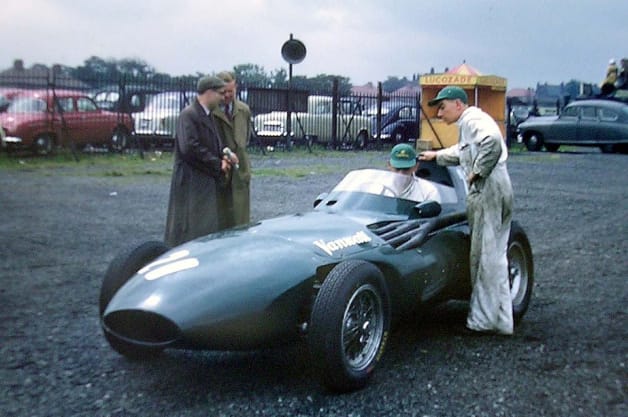
Have you heard about the time Stirling Moss used a teammate's car to finish a race and win his first Grand Prix in a British car? At the 1957 British Grand Prix at Aintree, Moss had to abandon his ailing car mid-race. He then took the wheel of his fatigued teammate's Vanwall in a 13-second swap, and continued the race. When a Maserati blew a clutch and took out a trailing Ferrari, Moss finished in first place, and shared the points with teammate Tony Brooks. The year prior, Juan Manuel Fangio crashed at Monaco, and finished second (to Stirling Moss, then driving for Ferrari) in his teammate's car.Have you heard about the time Stirling Moss used a teammate's car to finish a race?
Even the first Indianapolis 500, held in 1911, was won with the help of a relief driver. Ray Harroun finished first, but 35 of his laps were driven by Cyrus Patschke. Relief drivers remained a staple of the long-distance event, with co-winners being declared in 1924 and 1941.
For Formula One, the rules changed in 1958, but some drivers still continued to swap cars even if it meant scoring no points. In 1960 in Argentina, Moss ditched his broken car for that of Maurice Trintignant, but was awarded no points despite finishing third. In 1961, Moss was disqualified after his switch into Jack Fairman's car, the ruling attributed to illegal push assistance on the track from Fairman. In 1962, Lotus won a non-championship Mexican GP when Jim Clark took over for Trevor Taylor. By 1965, swapping cars meant automatic disqualification.By 1965, swapping cars meant automatic disqualification in Formula 1.
On September 13, on the streets of Beijing, Formula E will bring car swaps back to formula racing. This time, the act will be sanctioned, the rules unambiguous and the whole field will be doing it. Read about more notable car and driver swaps at the Formula E website.
Formula E sheds light on history of racecar swapping originally appeared on Autoblog Green on Mon, 08 Sep 2014 18:30:00 EST. Please see our terms for use of feeds.
Permalink | Email this | CommentsSource: http://green.autoblog.com/2014/09/08/formula-e-sheds-light-on-history-of-racecar-swapping/

No comments:
Post a Comment